

Will an AMR Hit People? Understanding the Safety Behind Reeman’s Industry-Leading Design
For many factory owners, the first question when considering robots is always:
“Will the robot hit people?”
“Is it safe in narrow aisles with workers walking around?”
These concerns come from past experiences with traditional AGVs. AGVs rely on magnetic strips or QR codes, cannot “see” their surroundings, and struggle with unexpected obstacles—leading to collisions, scraping, or complete shutdown.
Modern AMRs are completely different.
Reeman AMR takes safety to an industry-leading standard, far beyond AGVs or basic autonomous carts.
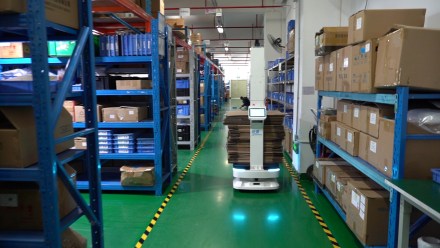
1. Whether a Robot Hits People Depends on What It Can See
① AGVs Cannot See the Real World
A traditional AGV:
-
Follows a magnetic or QR path
-
Cannot identify people or pallets
-
Reacts slowly
-
Often shuts down when obstacles appear
This is why AGVs frequently bump into goods or freeze in place.
② Reeman AMR Truly “Sees the World”
Reeman AMR uses LiDAR + 3D depth cameras for full 3D perception.
It can recognize:
-
Workers walking
-
Forklifts
-
Dollies and carts
-
Pallet edges
-
Low-lying objects
-
Temporary obstructions
Anything an AGV would hit—Reeman AMR can detect early and avoid automatically.
2. It Doesn’t Just See — It Predicts and Avoids Danger in Advance
Reeman AMR’s safety system uses predictive algorithms, similar to airline-grade navigation logic. The robot can:
-
Predict obstacle movement direction
-
Recalculate an optimal detour path
-
Bypass obstacles without stopping
-
Adjust braking distance based on speed
This means Reeman AMR doesn’t just avoid collisions—it proactively gives way to people.
3. Stable Operation Even in Human–Robot Mixed Environments
Real factories are chaotic:
-
Crowded aisles
-
Forklifts passing through
-
Temporary pallet storage
-
Workers walking across routes
AGVs collapse in such environments.
Reeman AMR, however, has been tested and deployed in thousands of factories and runs reliably even in ultra-narrow aisles.
Verified results:
Reeman AMRs safely pass workers in aisles as narrow as 90 cm, even 70 cm in certain scenarios.
4. Why Reeman Achieves Top-Level Industrial Safety
Reeman’s safety architecture includes:
-
Dual-layer perception:LiDAR + 3D vision
-
Dynamic multi-level safety zones
-
Obstacle prediction algorithms
-
Adaptive speed control
-
Soft-stop + hard-stop mechanisms
-
Proactive rerouting and anti-collision logic
-
Multi-robot anti-congestion coordination
This combination ensures the robot avoids not only people but also minimizes collisions, inventory damage, and accidental scrapes common in manual operations.
5. True Safety Isn’t “Stopping in Time”—It’s “Avoiding in Advance”
That’s why Reeman AMR has become the preferred choice in:
-
Electronics
-
3C manufacturing
-
New energy
-
Home appliances
-
High-density workshops
Factories trust Reeman because it delivers the highest level of autonomous safety—predictive, intelligent, and reliable.
もっと見る: Reemanbot

ロボット犬の価格帯は、コンシューマー向け最廉価のUnitree Go2 Airの1,600ドルから、フル構成のBoston Dynamics Spotエンタープライズ導入の195,000ドル以上まであります。研究用プラットフォームは2,890〜18,000ドル。産業用四足歩行ロボットはモデルと構成に応じて15,000〜88,000ドルです。適切な予算は、ユースケース、地形要件、オープンSDKアクセス・エンタープライズサポート・認定IP等級の必要性に完全に依存します。

広告ロボット:ブランドがエンゲージメントのためにモバイルサービスロボットを活用する方法

Reeman AMRロボット、自動車部品工場の重荷重輸送効率化を実現

Reeman AMRロボット:製造業向け柔軟なスマートソリューション

Reeman AMRロボットが産業物流と工場自動化を促進

Reeman AMRロボットで自動車部品工場の効率向上