
Reeman AMR Robot Enables Stable and High-Efficiency Logistics in Automotive Parts Manufacturing
公開日

Production Rhythm as the Core Challenge in Automotive Parts Logistics
In the automotive parts manufacturing industry, production complexity is significantly higher than in standard electronics assembly. Multi-variety components, small batch sizes, and frequent process switching have become the norm. Once internal logistics fall behind, overall production scheduling and delivery timelines are immediately affected.
After expanding its production capacity, a large automotive parts factory in Shenzhen identified internal logistics restructuring as a priority for sustaining stable operations.
Limitations of Manual Material Handling
The factory operates across multiple workshops, including injection molding, machining, and assembly. Components vary widely in specifications and circulate frequently between processes. Previously, material transport relied mainly on manual carts, resulting in random routing, unstable efficiency, and frequent congestion during peak periods.
Management recognized that simply adding labor could not solve these systemic issues. A smarter, more structured logistics approach was required to rebuild material flow efficiency.
Deploying Reeman AMR Robots for Workshop Logistics
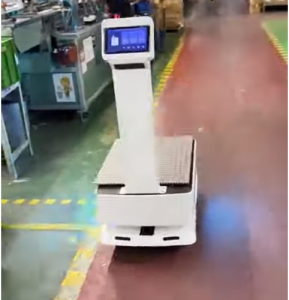
After evaluating multiple solutions, the factory introduced Reeman AMR material handling robots from the Big Dog Series with a 100 kg payload. These robots were deployed for standardized internal material transport within the workshop.
Unlike traditional automation systems, Reeman AMR robots require no fixed tracks or large-scale infrastructure changes. They can be flexibly deployed based on existing process layouts, allowing rapid integration into the current production system.
Building Predictable and Stable Material Flow
Once operational, Reeman AMR robots followed predefined process routes between storage areas and processing stations, creating a stable and predictable material flow rhythm. The system dynamically adjusts delivery frequency based on production plans, reducing uncertainty caused by manual scheduling.
In space-constrained automotive workshops, the robots’ stable operation in complex aisles also significantly reduced safety risks associated with mixed traffic between workers and equipment.
Operational Results and Long-Term Value
With internal logistics becoming more standardized, the factory achieved an overall improvement in material turnover efficiency without increasing manpower. The introduction of Reeman AMR robots transformed logistics from passively reacting to production needs into actively supporting production planning, laying a solid foundation for future capacity expansion.
もっと見る: Reemanbot

ロボット犬の価格帯は、コンシューマー向け最廉価のUnitree Go2 Airの1,600ドルから、フル構成のBoston Dynamics Spotエンタープライズ導入の195,000ドル以上まであります。研究用プラットフォームは2,890〜18,000ドル。産業用四足歩行ロボットはモデルと構成に応じて15,000〜88,000ドルです。適切な予算は、ユースケース、地形要件、オープンSDKアクセス・エンタープライズサポート・認定IP等級の必要性に完全に依存します。

広告ロボット:ブランドがエンゲージメントのためにモバイルサービスロボットを活用する方法

Reeman AMRロボット、自動車部品工場の重荷重輸送効率化を実現

Reeman AMRロボット:製造業向け柔軟なスマートソリューション

Reeman AMRロボットが産業物流と工場自動化を促進

Reeman AMRロボットで自動車部品工場の効率向上