
Reeman AMR Material Handling Robots Are Solving the Real Logistics Bottleneck in Factories
公開日

Why Factory Output Is Often Limited by Transport, Not Production Lines
Many factories operate advanced production equipment yet still struggle with unstable output. The root cause is often not machine capability, but internal material transport. Delayed material delivery, blocked workstations, and inefficient circulation gradually slow production rhythm, making capacity gains difficult to sustain.
Internal logistics functions like a factory’s bloodstream. When transport becomes unstable, even the most efficient production line is affected. This is why an increasing number of manufacturers are turning to Reeman AMR material handling robots capable of stable 24/7 operation.
The Hidden Cost of Manual Transport
Manual handling typically creates three major problems. First, instability caused by labor turnover, shift changes, or inconsistent execution. Second, frequent errors such as misdelivery, missed replenishment, or incorrect routing. Third, rising costs driven by night shifts, overtime, and multi-position coordination.
Once these hidden costs are calculated, many managers realize that automation is not an upgrade in speed, but a necessity for control. Reeman AMR material handling robots are designed specifically to eliminate these pain points.
Autonomous Operation Without Site Modification
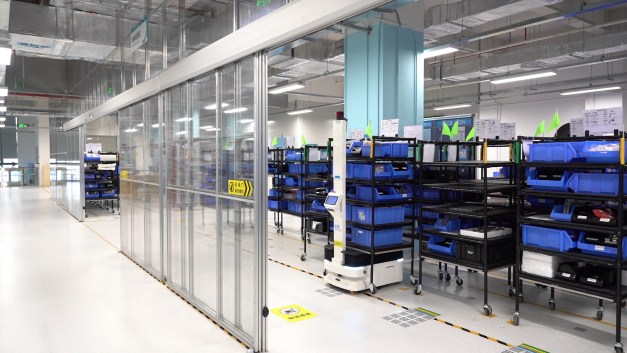
Reeman AMRs do not require magnetic tape, QR codes, reflectors, or closed aisles. Using LiDAR and 3D vision fusion, they build maps autonomously, plan optimal routes, recognize obstacles, and dynamically avoid people, forklifts, and carts.
They perform reliably in narrow aisles, legacy factories, and frequently changing production layouts. Even in mixed human-robot traffic, AMRs adjust speed and path in real time, maintaining safety while ensuring continuous transport.
From Manual Guesswork to Predictable Logistics Execution
By integrating with MES or WMS systems, Reeman AMR material handling robots automatically execute tasks such as material pickup, line-side replenishment, production feeding, and return-to-storage. Logistics actions become data-driven instead of experience-based.
When transport becomes predictable, production rhythm stabilizes naturally. Many factories discover that once logistics stops fluctuating, overall efficiency improves with minimal changes to production equipment.
Why Stability Matters More Than Speed
Experienced manufacturers eventually realize that transport does not need to be fast, but consistently reliable. Reeman AMRs are widely adopted because they rarely stop due to temporary obstacles, lighting changes, or congestion.
One robot can typically replace two to three transport workers and operate continuously throughout the year. In labor-constrained industries, this stability becomes a decisive competitive advantage.
もっと見る: Reemanbot

ロボット犬の価格帯は、コンシューマー向け最廉価のUnitree Go2 Airの1,600ドルから、フル構成のBoston Dynamics Spotエンタープライズ導入の195,000ドル以上まであります。研究用プラットフォームは2,890〜18,000ドル。産業用四足歩行ロボットはモデルと構成に応じて15,000〜88,000ドルです。適切な予算は、ユースケース、地形要件、オープンSDKアクセス・エンタープライズサポート・認定IP等級の必要性に完全に依存します。

広告ロボット:ブランドがエンゲージメントのためにモバイルサービスロボットを活用する方法

Reeman AMRロボット、自動車部品工場の重荷重輸送効率化を実現

Reeman AMRロボット:製造業向け柔軟なスマートソリューション

Reeman AMRロボットが産業物流と工場自動化を促進

Reeman AMRロボットで自動車部品工場の効率向上